From Extraction to Regeneration: The New Coordination Economy

Beyond the Attention Economy
The digital economy has taught us a harsh lesson: when platforms harvest value from the many to concentrate it in the hands of a few, everyone loses except the few at the top. We've watched social networks turn connection into surveillance, search engines transform curiosity into targeting data, and marketplaces convert community into monopoly power. But what if there was another way?
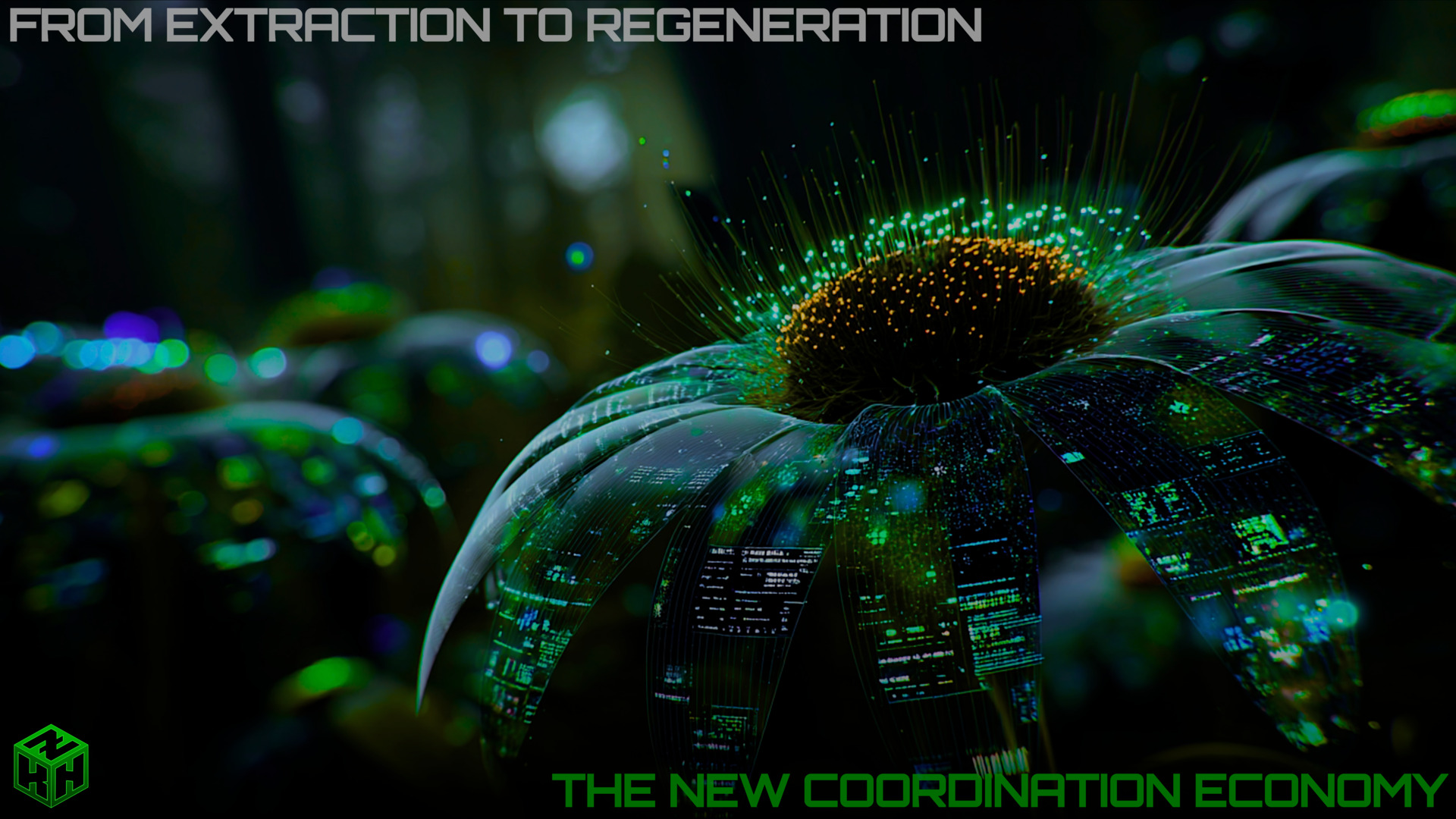
Enter regenerative coordination - a paradigm shift that treats digital networks not as extraction machines, but as living ecosystems where every participant strengthens the whole. It's the difference between strip-mining and permaculture, between a casino and a commons.
What Makes Coordination "Regenerative"?
At its core, ZKNetwork’s regenerative coordination inverts the old platform playbook. Rather than optimizing for maximum extraction from participants, it maximizes value creation for all participants by using cryptographic proof of participation.
Traditional Model:
Platform
↳ Extracts from Users
↳ Enriches Owners
Regenerative Model:
Network
↳ Creates Value
↳ Flows Back to Participants
↳ Strengthens Network
↳ Creates More Value
This isn't just feel-good philosophy. It's a structural transformation enabled by three converging technologies:
- Cryptographic verification (ensuring trust without intermediaries)
- Token economics (programmable incentives)
- Decentralized networks (removing gatekeepers)
The Shift from Attention to Intention
The last era of the internet monetized our wandering attention - endless scrolling, clickbait headlines, dopamine-driven engagement metrics. The regenerative economy operates on intention instead. When networks organize around what participants truly need and want to build, value emerges from purposeful action rather than manipulated behavior.
Zero Knowledge Network embodies this shift. Users don't trade their privacy for services; they participate in a system where privacy itself is a core utility and the foundation for coordination as a privacy-first exchange of communications and data between people, devices, AI agents, and organizations. Node operators don't compete in a zero-sum game; they collaborate in a positive-sum ecosystem where network growth benefits everyone.
Nature as the Blueprint
Regenerative systems take their cues from nature. In a forest, fallen leaves don't represent waste - they become nutrients that feed the soil, which nourishes the trees, which drop more leaves. Every cycle strengthens the system.
Similarly, in ZKNetwork’s regenerative model:
- Incoming value isn’t extracted outward; it flows into pools, creating a positive-sum cycle of stability and growth.
- These strategic pools fund new initiatives.
- Those initiatives generate additional utility for the network.
- Greater utility attracts more users and operators.
- Continued growth produces more revenue, continuing the cycle.
The Three Pillars of Regenerative Coordination
1. Social Regeneration: Building high-trust digital networks where relationships strengthen rather than commodify human connection. In ZKNetwork, this means privacy-preserving communication and data exchange that protects rather than exploits social graphs.
2. Economic Regeneration: Creating value loops where capital strengthens the commons rather than extracting from it. Revenue flows back into ecosystem development, node operator rewards, and community initiatives.
3. Ecological Regeneration: Designing systems that mirror nature's resilience and adaptability. The network grows stronger through diversity, redundancy, and organic evolution rather than relying on brittle, centralized structures that collapse under stress.
Why This Matters Now
We're entering what many call the Intelligence Era, where AI agents will increasingly handle coordination tasks. The question is: will these systems follow the extractive patterns of Web2, or will they embody regenerative principles?
ZKNetwork's answer is clear: build the regenerative infrastructure now, before extractive patterns become locked in. Make privacy the default, verification the standard, and value circulation the norm. Create systems where humans and machines coordinate for collective prosperity, not platform profit.
What's Next
In Part II, we'll dive deep into the mechanics - how ZKNetwork’s regenerative flywheel actually works, the role of tokenomics in creating sustainable coordination, and why "fluid collectivism" represents the future of decentralized optimization.