The Regenerative-DePIN Flywheel: Engineering Coordination at Scale

In Part I of this three-part series, we explored how regenerative coordination transforms digital networks from extraction machines into living ecosystems, where intention replaces attention and nature's patterns inspire resilient systems. Now, let's dive into the mechanics - the actual engines that make regenerative coordination work at scale.
The Dual Engine Model
Traditional DePIN (Decentralized Physical Infrastructure) networks operate on a simple flywheel: operators provide resources → users pay for services → value accrues to token → attracts more operators. It works, but it's only half the story.
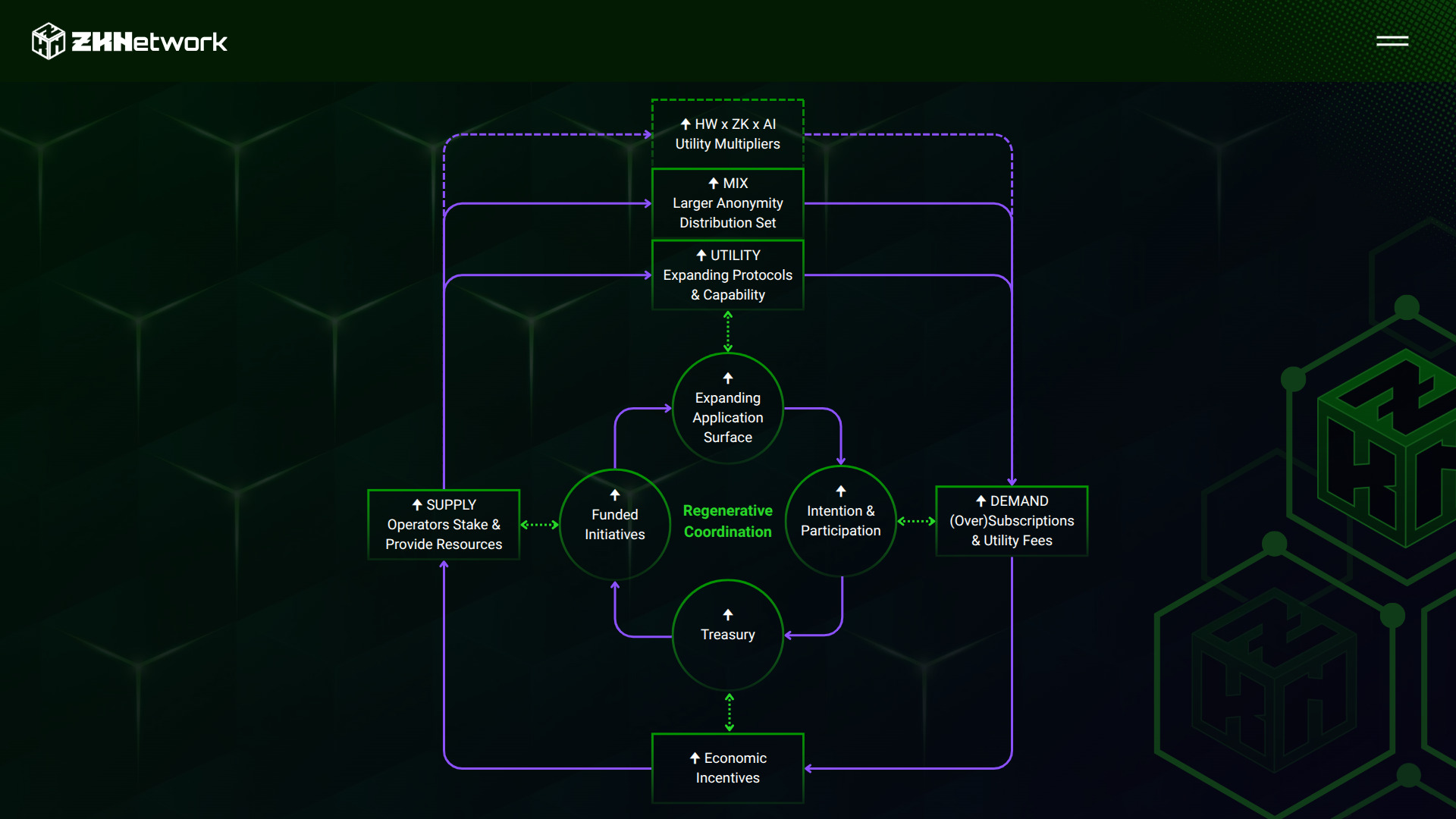
ZKNetwork operates on a dual flywheel model, the Regenerative-DePIN Flywheel, where DePIN revenue interlocks with regenerative on-chain coordination.These two engines don't just coexist - they amplify each other, creating compound effects that accelerate network growth while ensuring sustainability and supporting token value.
The result is Balanced Regenerative Equilibrium: revenue flows in as energy, while the token side absorbs and transforms it – locking supply, aligning incentives, and funding the builders who feed the next cycle.
Understanding the Regenerative Flywheel
Let's break down how value actually flows through the system:
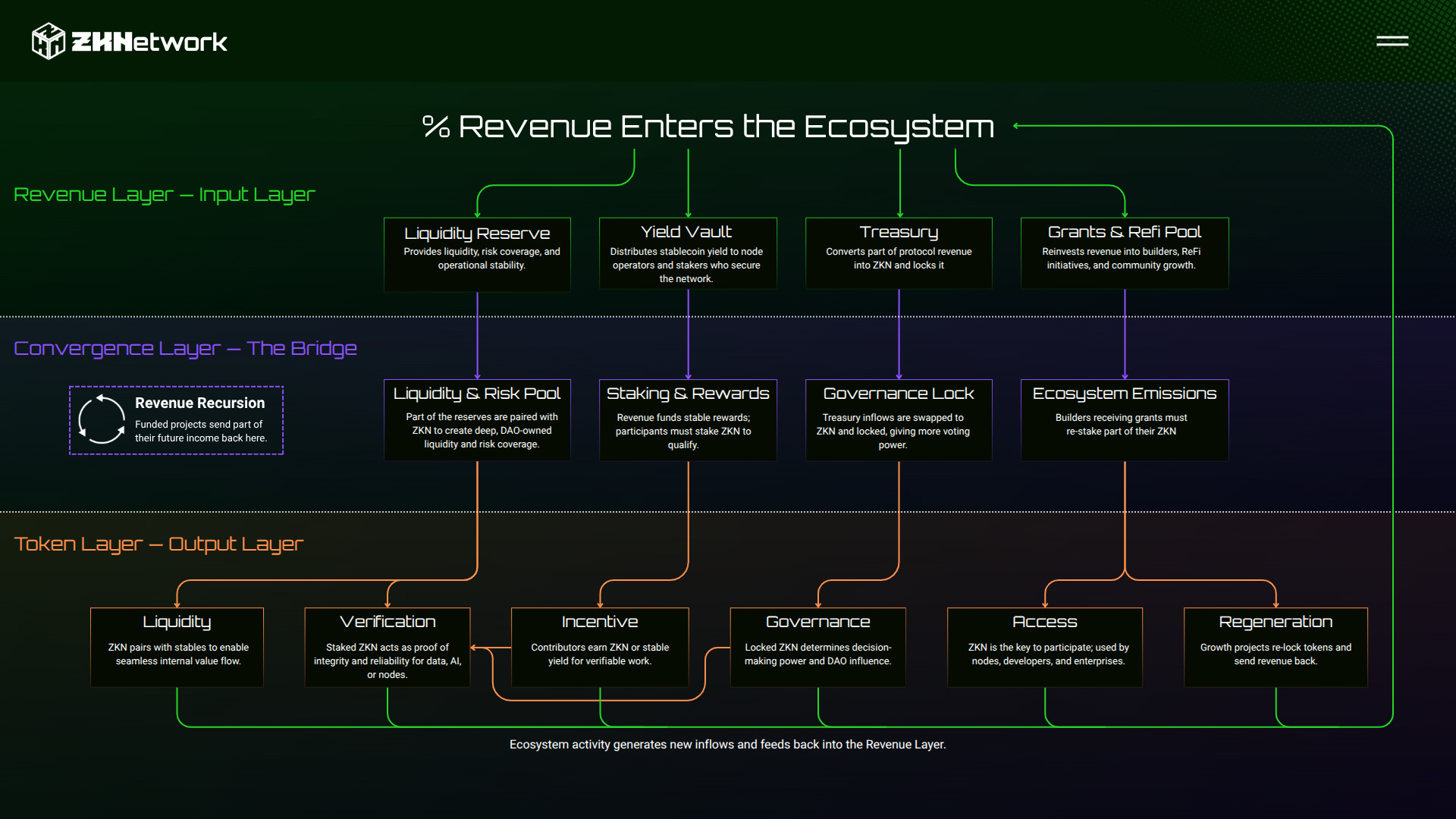
The Revenue Layer (Input)
- Users and enterprises provide stablecoin inflows (predictable, accessible)
- These payments split into four streams:
- Yield vault (rewards for operators and stakers)
- Treasury (converted to ZKN tokens and locked)
- Grants & ReFi Pool (funding builders and initiatives)
- Liquidity Reserves (stability buffer and liquidity provisioning)
The Convergence Layer (The Bridge) Here's where it gets interesting. Revenue doesn't just flow one way - it creates feedback loops:
- Funded projects commit to revenue recursion, sending part of their future income back
- Treasury automatically converts stable inflows to locked ZKN, reducing circulating supply
- ZKN lockup is mandatory for stable rewards, constraining circulating supply
- Governance participation requires token locking, aligning long-term incentives
The Token Layer (Output) The ZKN token becomes more than a speculative asset - it's the network's circulatory system:
- Liquidity: Paired with stables for seamless value flow
- Verification: Staked as proof of honest behavior
- Incentive: Rewards earned for verifiable network value
- Governance: Voting power proportional to commitment
- Access: Required for network participation
- Regeneration: Growth loops back to create more value
Fluid Collectivism: Governance That Adapts
Traditional DAOs often suffer from rigid structures - fixed voting periods, static proposals, binary decisions. ZKNetwork embraces fluid collectivism, where governance adapts dynamically to network needs.
Think of it like a jazz ensemble rather than a symphony orchestra. Instead of following a fixed score, participants respond to each other in real-time, creating emergent harmony through aligned incentives and continuous feedback.
Key innovations:
- Continuous Optimization: Incentives and parameters adjust based on network performance
- Multi-stakeholder Alignment: Different participant types (users, operators, builders) have balanced influence
- Purpose-Driven Distribution: Rewards flow to where they create most value
- Agent Participation: AI agents stake ZKN and earn rewards for enhancing verifiable coordination connectivity
The Mathematics of Regeneration
Let's look at the actual economic mechanics:
Traditional Platform Economics:
- Platform takes 20-30% of all transactions
- Value extracted = (Total Revenue × Platform Cut)
- User value = Service - (Privacy Loss + Data Exploitation)
Regenerative Network Economics:
- Network revenue funds four strategic areas: operational costs, growth investment, stable yield, and locked value reserve
- Value created = (Network Effects × Participant Contributions)
- User value = Service + Privacy + Ownership Stake + Governance Rights
The key difference: in traditional models, value extraction scales linearly with usage. In regenerative models, value creation scales exponentially with participation.
Solving the DePIN Trilemma
Most DePIN networks face three competing pressures:
- Operator Sustainability: Rewards must justify infrastructure costs
- User Affordability: Services must be competitively priced
- Token Appreciation: Investors need returns
ZKNetwork's dual-flywheel solves this through:
- Stablecoin Revenue: Predictable income independent of token volatility
- Stable Payouts: Stablecoin yield rewards operators, reducing ZKN sell pressure and token volatility
- Oversubscription Efficiency: Networks can sell more capacity than raw supply, for some utilities
- Treasury Compounding: Revenue converted to tokens creates buy pressure without dilution
- Multi-stream Value: Operators earn from rewards, users, and token appreciation
The Network Effect Multiplier
Traditional network effects: More users → More valuable to each user
Regenerative network effects: More users → More operators → More services → More treasury → More funded initiatives → More utility → More users (and the cycle accelerates)
Each loop strengthens multiple aspects:
- Technical: More nodes = better performance and resilience
- Economic: More revenue = larger treasury = more growth funding
- Social: More participants = richer ecosystem = stronger community
- Governance: More stakeholders = better decisions = improved protocol
Real-World Application: The Privacy Stack
Here's how regenerative coordination works in practice with ZKNetwork's privacy infrastructure:
- Users need metadata-private communication
- They subscribe to MIX network services (paid in stables)
- Revenue funds node operators, growth, and reserves (ensuring quality service)
- Excess revenue goes to treasury (converted to ZKN)
- Grants Pool funds privacy tool development (expanding ecosystem).
- New tools attract more users
- Cycle repeats with increasing momentum
What's Next
In Part III, we'll explore the bigger picture - how regenerative coordination becomes the foundation for human-AI alignment, the emergence of "coordination as a protocol," and what this means for the future of digital society.