Coordination as a Protocol: Building the Regenerative Future

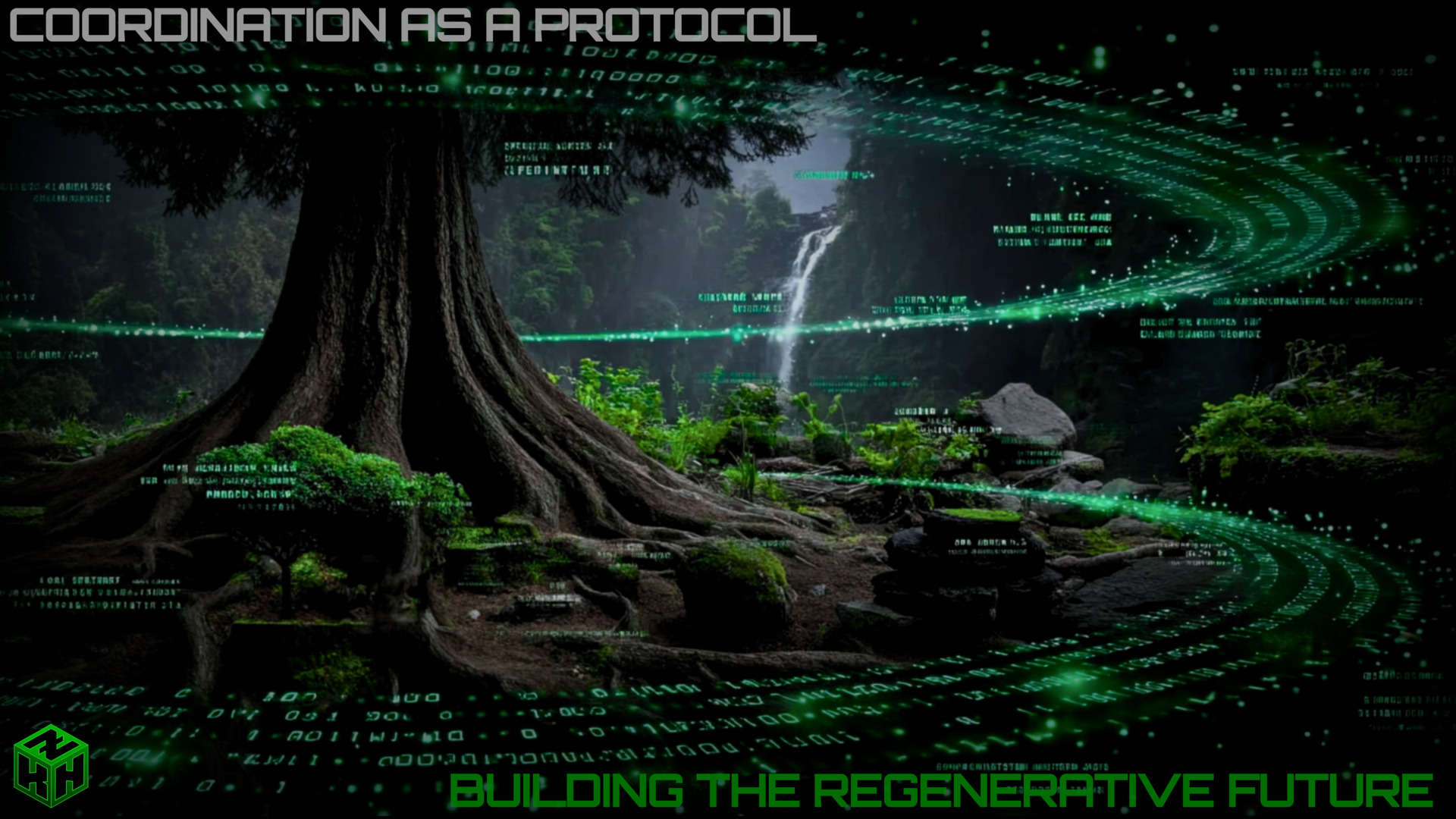
In Part I of this series, we explored how regenerative coordination transforms digital networks from extraction machines into living ecosystems, where intention replaces attention and nature's resilience inspires system design. In Part II, we examined the mechanics: how ZKNetwork's dual-flywheel model interlocks DePIN revenue with regenerative tokenomics, creating compound value through fluid collectivism. Now, in this final installment, we step back to see the bigger picture: how coordination itself becomes a protocol, what this means for human-AI alignment, and why building regenerative infrastructure now will shape digital society for generations to come.
From Coordination to Meta-Coordination
We've explored how regenerative systems create value and how flywheels generate sustainable growth. Now let's zoom out to the bigger picture: what happens when coordination itself becomes a protocol - a reusable, composable building block that any community can deploy?
Zero Knowledge Network isn't just building privacy infrastructure; it's creating a coordination operating system for the Intelligence Era. ZKNetwork’s on-chain coordination isn't merely governing its network of protocols - it's becoming a packaged meta-utility that demonstrates how humans and machines can collaborate regeneratively at scale.
The Intelligence Era Challenge
As AI agents proliferate, we face a critical question: who controls the coordination layer? If we follow Web2's path, a few corporations will own the rails on which billions of autonomous agents operate. The alternative - regenerative coordination - ensures these systems remain open, verifiable, and aligned with collective prosperity.
ZKNetwork's approach treats coordination as a public good, like roads or the internet protocol itself. Anyone can use it, no one can exclusively capture it, and everyone benefits from improvements.
Three Principles for Machine-Human Coordination
1. Least Disclosure: Share only what's necessary, even with authorized parties. When AI agents coordinate through ZKNetwork, they reveal intentions and capabilities without exposing sensitive data or metadata.
2. Maximum Verification: Every action must be cryptographically provable. In a world of deepfakes and synthetic content, "don't trust, verify" becomes existential.
3. Least Privilege: Grant only essential permissions. This prevents both human exploitation and AI overreach, ensuring bounded autonomy within defined parameters.
These principles create a secured trust loop where coordination happens fluidly without surveillance or manipulation.
Regenerative Coordination in Action
Let's explore concrete examples of how this transforms different sectors:
Distributed Energy Markets
- Local solar producers contribute excess energy
- Smart contracts coordinate distribution based on demand
- Privacy preserves competitive advantages and physical safety
- Revenue flows back to infrastructure investment
- Communities become energy sovereign
Supply Chain Integrity
- Each component has a cryptographic identity
- Changes are tracked without revealing suppliers
- Compromised parts trigger automatic alerts
- Value flows to quality producers
- Trust emerges from verification, not brand
Community Governance
- Proposals are submitted with verifiable intent
- Voting happens privately but verifiably
- Resources are allocated algorithmically
- Success metrics trigger automated rewards
- Evolution happens through continuous optimization
The Stigmergic Network
ZKNetwork embodies stigmergy - a form of self-organization where actions leave traces that guide future actions. Like ants creating trails to food sources, network participants signal opportunities through their contributions.
In regenerative coordination:
- Successful patterns get reinforced through rewards
- Failed experiments are quickly abandoned
- Innovation emerges from the edges
- No central authority dictates evolution
- The system becomes antifragile through diversity
Scaling Beyond Technology
Regenerative coordination isn't just about better technology - it's about enabling new forms of human organization:
Bioregional Coordination: Communities organized around ecological boundaries rather than political ones, sharing resources and knowledge while maintaining local autonomy.
Translocal Cooperation: Groups with similar goals but different contexts (urban farms in Detroit and São Paulo) share learnings without homogenization.
Temporal Coordination: Current actions consider future generations through cryptographic commitments and locked value that appreciates over time.
The Path to Adoption
How does regenerative coordination move from concept to reality?
Phase 1: Infrastructure (Now)
- Build privacy-preserving communication layers
- Deploy token mechanics that create sustainable incentives
- Prove the model with early adopters
Phase 2: Expansion (Months)
- Package coordination tools for easy deployment
- Enable cross-network interoperability
- Scale through enterprise partnerships
Phase 3: Evolution (Years)
- AI agents autonomously coordinate through the protocol
- Governance becomes fully algorithmic where appropriate
- New coordination patterns emerge organically
Phase 4: Transformation (Decade)
- Regenerative coordination becomes the default
- Extractive platforms become obsolete
- Digital and physical systems merge seamlessly
The Stakes
We're not just choosing between different technologies - we're choosing between different futures:
Extractive Future:
- AI controlled by megacorporations
- Surveillance as the price of participation
- Value concentrated in fewer hands
- Democracy undermined by algorithmic manipulation
Regenerative Future:
- AI serving collective prosperity
- Privacy as fundamental infrastructure
- Value flowing to contributors
- Democracy enhanced through verifiable coordination
Building Together
Regenerative coordination can't be imposed - it must be cultivated. Every participant who runs a node, stakes tokens, builds applications, or simply uses privacy-preserving services is voting for the regenerative future.
This isn't just idealism; it's pragmatic system design. Networks that regenerate are more resilient, innovative, and valuable than those that extract. They attract better talent, generate more sustainable revenue, and create lasting value.
The Invitation
Zero Knowledge Network extends an open invitation: Be the Network.
Not just a user consuming services. Not just an investor seeking returns. But an active participant in building the coordination layer for the Intelligence Era. Whether you're a developer creating privacy tools, a community organizer deploying governance modules, or simply someone who believes in digital dignity - there's a place for you in the regenerative economy.
Conclusion: The Regenerative Imperative
As we stand at the threshold of the Intelligence Era, the choices we make about coordination will ripple for generations. Will we repeat the mistakes of Web2, allowing new intermediaries to capture the value created by human-AI collaboration? Or will we build regenerative systems that ensure prosperity flows to all participants?
ZKNetwork's dual-flywheel model, powered by privacy-first infrastructure and regenerative tokenomics, offers a concrete path forward. It's not just a better DePIN or a more sophisticated DAO - it's a demonstration that coordination itself can be regenerative, that extraction isn't inevitable, and that technology can serve collective flourishing.
The flywheel is already spinning. The question isn't whether regenerative coordination will emerge, but whether you'll help build it. The future doesn't need more platforms. It needs more gardens - spaces where value grows, circulates, and regenerates.
Welcome to regenerative coordination. Welcome to the network that strengthens with every cycle. Welcome to building the future where privacy, prosperity, and collective agency converge.
Be the Network.